Basement Waterproofing in Akron, OH
On an older Akron foundation, water does not need a crack to get in. It comes through the mortar joints, and in hollow block it fills the blocks themselves. That single fact explains why some very expensive repairs here do nothing.
In Akron, an interior perimeter drain to a sump runs $65-130 per linear foot, so a typical whole-basement job is $6,500-15,000. Exterior excavation and membrane is $150-320 per foot - roughly double, and worth it only in specific situations.
Downspout extensions and regrading cost $300-1,500 and resolve a meaningful share of wet basements outright. Any contractor who quotes an interior system without asking where your downspouts discharge has skipped the diagnosis.
Much of Akron's older stock sits on sandstone block or hollow cinder block. These leak through mortar joints and block cores rather than through a single crack, which is why crack injection - excellent on a poured wall - is the wrong product here.
Three foundation types, three different problems
| Foundation | How water gets in | What actually works |
|---|---|---|
| Poured concrete (newer) | Through discrete cracks | Crack injection is genuinely effective and cheap |
| Hollow cinder block | Through joints, then fills the block cores | Drainage plus weep holes to release the cores |
| Sandstone block (oldest) | Through deteriorated mortar across the whole wall | Tuckpointing plus drainage; injection does nothing |
The hollow block case is the one most often mishandled. Because the cores fill with water, sealing the inside face of the wall traps that water inside the block, where the next freeze can crack it. A contractor working on block should be talking about relieving the cores, not just about coating the surface.
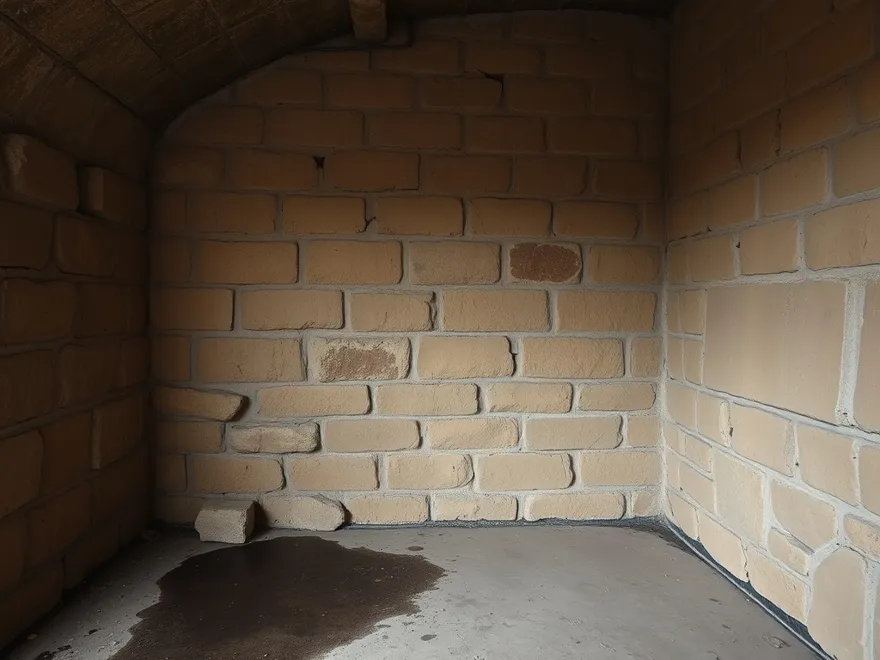
What freeze-thaw does to an old wall
Water saturates the mortar. It freezes and expands by roughly nine per cent. The mortar cracks microscopically. It thaws, takes on a little more water, and does it again - dozens of times a winter in northeast Ohio.
Over decades that process turns hard lime mortar into something you can rake out with a screwdriver. The wall is still structurally sound long after it has stopped being watertight, which is why plenty of Akron basements leak steadily without anything looking dramatic.
This is also why the cheap surface treatments fail here specifically. A sealer painted on the inside does not stop water entering the wall - it just stops it evaporating on the inside face, so the wall stays wetter and the freeze-thaw damage accelerates.
Do these first
- title
- items
It is worth being blunt about why this order matters. Interior drainage is the most profitable product in this trade. It is also genuinely the right answer for plenty of Akron houses. The way to tell which situation you are in is to fix the cheap things first and see what is left.
Interior versus exterior
| Interior drainage | Exterior excavation | |
|---|---|---|
| Typical Akron cost | $65-130 per foot | $150-320 per foot |
| What it does | Collects water that has entered and pumps it out | Stops water reaching the wall at all |
| Disruption | Inside: concrete cut, dust, days | Outside: landscaping, patio, deck may go |
| Best for | Most houses, most budgets | A wall that is failing structurally, or a finished basement you cannot disturb |
| Weak point | Relies on a pump and therefore on power | Cost, and access around the house |
If you go interior, a battery backup on the sump is not optional in this climate. The heaviest water events here often coincide with the storms that take the power out.
Ask whether the discharge line is protected against freezing. A sump that runs into a line that ices up in January is a sump that backs up into your basement.
Common questions
Does waterproof paint work?
On a dry poured wall with light dampness, it can help. On a saturated block or sandstone wall it fails, usually by blistering off and taking mortar surface with it - and it makes the underlying freeze-thaw damage worse by keeping the wall wet. It is not a substitute for drainage.
How long does an interior system take?
Typically two to four days for a whole basement, including breaking out the perimeter of the floor, laying pipe and stone, setting the sump, and re-concreting. It is dusty and loud, and a good contractor will tell you that upfront.
Are the lifetime warranties real?
They are as real as the company. Ask how long they have traded under that name, whether it transfers to a buyer, and what it excludes. Most exclude water entering anywhere other than through the system - which, on a sandstone wall, can be quite a lot of places.
Will this fix the musty smell?
Usually, but not always immediately. If drywall, framing or stored contents got wet repeatedly, the smell lives in those materials and they need removing or drying properly. Stopping the water is step one, not the whole job.
Do I need a permit in Akron?
Interior drainage and sump installation generally require a plumbing permit in Summit County jurisdictions, and exterior excavation may need one too. Your contractor should handle it. Work done without a permit tends to surface during a sale.
- Akron
- Cuyahoga Falls
- Stow
- Barberton
- Green
- Tallmadge
- Fairlawn
- Norton
Get written quotes for your basement
Tell us what kind of foundation you have if you know - poured, block or sandstone - and when the water appears. Those two answers determine most of the quote. One local contractor, no charge, no obligation.
Or call (877) 701-2518